Home / Topics / Family meeting
Family meeting · Guide
Lines in the sand: how to set your family’s triggers
The best time to decide when to leave is long before you have to.
What it is
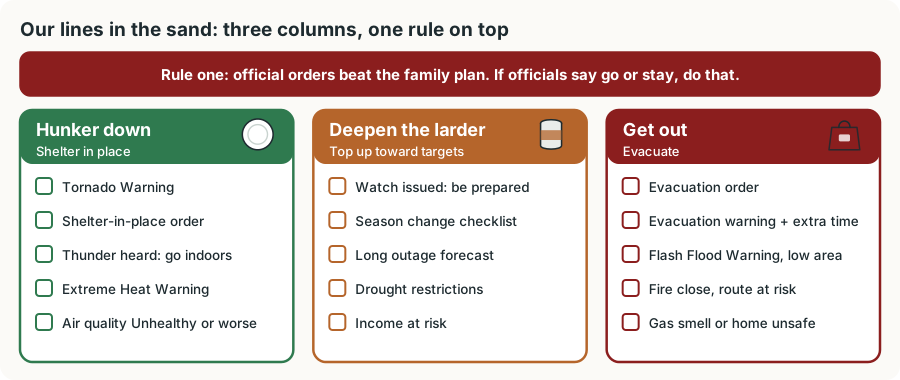
A one-page agreement your household makes in calm times: “If this happens, we do that.” It turns official alerts into decisions you have already talked through, so nobody has to argue in the driveway.
Why decide ahead
Disasters move fast. Ready.gov says to leave early enough to avoid being trapped by severe weather[1], and Be Ready Utah says that if you feel your location or route may become unsafe, don’t wait for an alert.[2] With debris flows, by the time you are sure one is coming it is too late to get away safely.[3] Deciding ahead removes the hesitation.
Know what the alerts mean
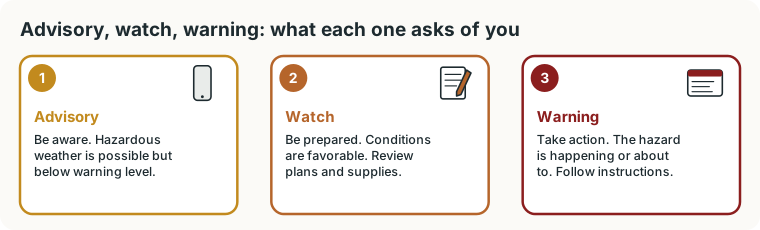
The National Weather Service uses three levels. An advisory is for an event that may become a nuisance. A watch means conditions are favorable for the hazard, so it is possible. A warning means the hazard is imminent or already happening.[4] A Red Flag Warning means critical fire weather is happening or about to.[5] For evacuations, FEMA describes an order as a directive to leave immediately because of imminent danger.[6] County terms for a step before an order, often called a warning, vary; check yours.
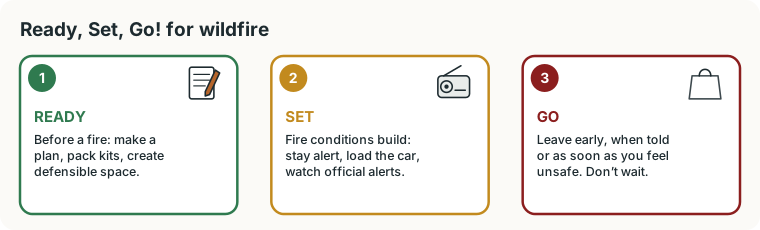
Fire departments use the IAFC’s Ready, Set, Go! program: get ready before a fire, stay aware as conditions develop, and act quickly and decisively when a fire threatens.[7]
How to fill it in (20 minutes)
- Read rule one aloud: official orders beat the family plan.
- Go column by column. Tick each suggested signal that applies to where you live. Skip what doesn’t (a tornado signal matters less in a slot canyon town; flash floods matter more).
- Add your own lines. Examples: “If Grandpa’s oxygen concentrator has less than 4 hours of battery, we go to Aunt Sue’s.” “If the creek behind us is over the bank, we leave.” Base them on things you can actually see or that officials announce.
- Fill in who decides, where you meet, your evacuation zone, and how you get alerts.
- Print a copy for the fridge, each go bag, and the binder.
- Review every 13 weeks at your family meeting (weeks 13, 26, 39, and 52).
What “deepen the larder” means here
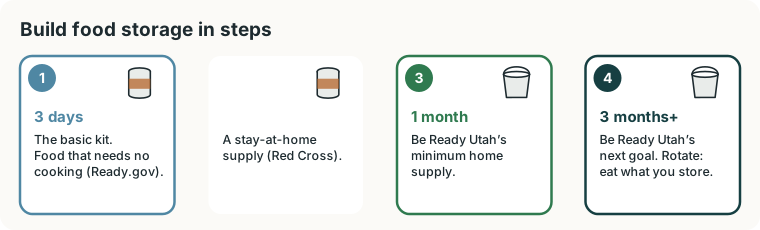
It means moving up to the next target, not panic buying. Ready.gov’s basic kit covers 3 days of food that needs no cooking[8]; the Red Cross describes a 2-week stay-at-home kit[9]; and Be Ready Utah says to store at least one month and work toward three months.[10] Build gradually and don’t go into debt.[10]
Where it lives
On the fridge, in each go bag, and in the binder. The planner can also remember your answers in this browser if you choose.
Sources
- FEMA / Ready.gov: Evacuation
- Utah DEM / Be Ready Utah: Wildfire
- FEMA / Ready.gov: Landslides & Debris Flow
- NOAA National Weather Service: Flood Watch vs. Warning
- NOAA National Weather Service: Understanding Wildfire Warnings, Watches and Behavior
- FEMA: Disaster-Related FAQ
- International Association of Fire Chiefs: Ready, Set, Go! (IAFC Wildfire Resilience Hub)
- FEMA / Ready.gov: Food
- American Red Cross: Wildfire Safety
- Utah DEM / Be Ready Utah: Food (12 Areas)
Official pages checked 16 November 2026. Guidance changes; follow your local officials first. How we research.
Page checked on · Change log · Report an error · Calm by design