Start here
Your first month of getting ready
You do not need to do everything at once. Be Ready Utah notes that a kit does not have to cost a lot and that most items can be gathered from around your home.[1] See also Ready.gov: Low and No Cost Preparedness.
Week 1: Get alerts and make a plan
- Sign up for your community’s warning system.[3] In Utah, Be Ready Utah says to sign up for emergency phone alerts from your county emergency management.[4]
- Know the main national alert channels: Wireless Emergency Alerts are short alerts sent to WEA-enabled phones in a targeted area, and NOAA Weather Radio broadcasts official warnings 24 hours a day.[5][6]
- Sit down with your household and fill in the family emergency plan worksheet. Ready.gov’s four steps are: meet with your family, assess your household needs, document your plan, and practice it.[7]
Week 2: Start a kit
- Use the 72-hour kit checklist and check off what you already own.
- Keep the kit in a designated place and make sure everyone knows where it is.[8]
- Plan for home, work, and car, since you do not know where you will be when an emergency happens.[8]
Week 3: Store water
- Work out your number with the water storage calculator.
- Start with store-bought bottled water. CDC calls unopened, commercially bottled water the safest and most reliable emergency source.[9]
Week 4: Documents and practice
- Save copies of insurance policies, IDs, and bank records electronically or in a waterproof, portable container.[8]
- Practice your plan. The Red Cross suggests practicing evacuating your home twice a year, including driving your planned route.[10]
- Re-think your needs every year and update your kit as your family changes.[8]
Live in Southern Utah?
Add the regional steps in the Southern Utah hazards overview, including Washington County’s evacuation-zone lookup.
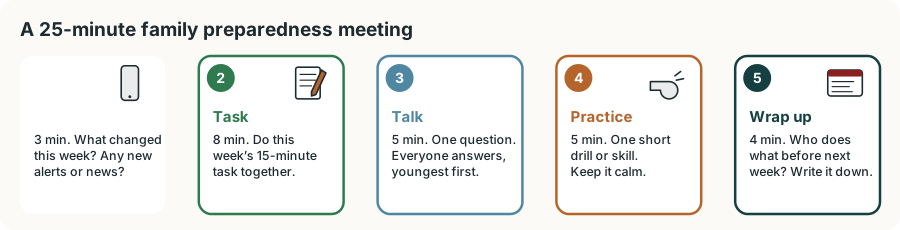
Do this as a family. Each week has a ready-made 25-minute family meeting: this week’s task, one question to talk about, and a 5-minute practice. Every 13 weeks, review your family trigger planner: what signals mean hunker down, deepen the larder, or get out.
Sources
- Utah DEM / Be Ready Utah: Get a Kit: Family
- FEMA / Ready.gov: Low and No Cost Preparedness
- FEMA / Ready.gov: Floods
- Utah DEM / Be Ready Utah: Wildfire
- FEMA / Ready.gov: Emergency Alerts
- NOAA National Weather Service: NOAA Weather Radio
- FEMA / Ready.gov: Make a Plan
- FEMA / Ready.gov: Build A Kit
- CDC: How to Create an Emergency Water Supply
- American Red Cross: Make a Plan
Official pages checked 14 November 2026. Guidance changes; follow your local officials first. How we research.
Page checked on · Change log · Report an error · Calm by design