Topic hub · Complete guide
Emergency food: the complete guide
After a disaster, power outages could last for several days.[1] Stored food you already like, rotated through everyday meals, carries your household through. This guide covers what to store, why, when, how much, where, and how to keep it safe.
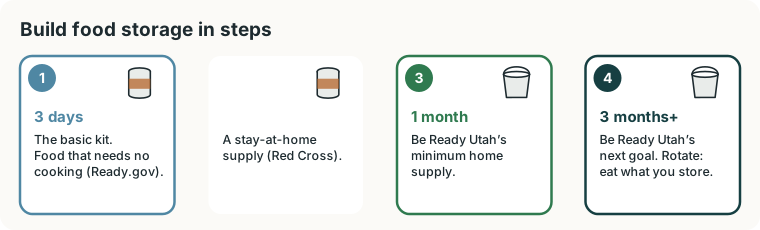
Short version: keep at least a several-day supply of non-perishable food and a manual can opener (Ready.gov)[1], and build toward one month or more (Be Ready Utah)[2]. In an outage, an unopened fridge keeps food safe up to 4 hours, and a full freezer about 48 hours.[3] When in doubt, throw it out.
What to store
Food that doesn’t need refrigeration, cooking, water, or special preparation, chosen from what your family already eats, with special diets covered.[1] See building a food supply and no-cook meals.
Why it matters
A power outage can close grocery stores, gas stations, ATMs, and banks.[4] Be Ready Utah notes that you can only last up to three or four weeks without proper nutrition.[2]
When: rotate and check
- Rotate stored food through everyday meals: eat what you store, store what you eat.[2]
- Check cans for swelling, dents, or corrosion and toss any damaged ones.[1]
- Learn skills like grinding grain, baking bread, and canning now, while mistakes are cheap.[2]
Where to keep it
Cool, dark, and dry, indoors and low, off floors and walls. Heat is the enemy: Be Ready Utah says every 18°F above the 40–70°F range halves shelf life.[2]
How to keep it safe
- During a power outage: the 4-hour and 48/24-hour rules, and USDA’s keep-or-toss list.
- After a flood or fire: what to discard and how to salvage cans.
- Preserving at home: canning safety, dehydrating, and jerky.
Food guides
Build and rotate a food supply
How much, what to buy, and FIFO storage.
How-toNo-cook emergency meals
Meal ideas and safe warming.
How-toFood safety in a power outage
Keep-or-toss rules from USDA.
How-toAfter a flood or fire
What to toss; salvaging cans.
GuideHome canning safety
Botulism, canners, altitude, and spoilage signs.
How-toDehydrate food
Dryness tests, packaging, and shelf life.
How-toMake jerky safely
USDA’s 160°F rule and NCHFP methods.
FAQFood FAQ
Answers to the most common food questions.
Official guidance
- Ready.gov: Food
- USDA: Keep Your Food Safe During Emergencies
- Be Ready Utah: Food
- National Center for Home Food Preservation
Sources
- FEMA / Ready.gov: Food
- Utah DEM / Be Ready Utah: Food (12 Areas)
- USDA Food Safety and Inspection Service: Keep Your Food Safe During Emergencies
- FEMA / Ready.gov: Power Outages
- National Center for Home Food Preservation (Univ. of Georgia): National Center for Home Food Preservation
Official pages checked 14 November 2026. Guidance changes; follow your local officials first. How we research.
Page checked on · Change log · Report an error · Calm by design