Family meeting
Weekly family preparedness meeting
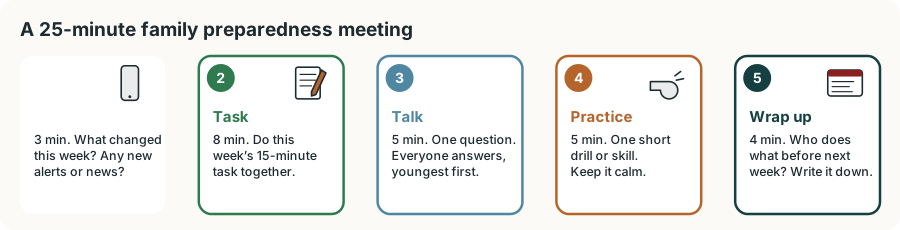
Twenty-five minutes, once a week, with everyone at the table. Each meeting pairs this week’s 15-minute task with one question to talk about and one short thing to practice.
Start with week 1, or pick this week from the list below.
The week number matches Prep in 15 minutes a week: week 1 starts on 1 January.
Why meet every week
Ready.gov says to practice your plan with your household.[1] Be Ready Utah suggests table-top practice and “what-if” games to find holes in your plans, then physically running through them, because we learn by doing more than by listening.[2] The Red Cross says to practice evacuating your home twice a year.[3] A short weekly meeting makes that a habit instead of a once-a-year scramble.
How to run it
- Same time each week. After a family dinner works for many households.
- Open this week’s meeting page (or print the meeting sheet).
- Follow the five steps: check in, do the task, talk, practice, wrap up.
- Write down who does what. Start next week by checking those off.
- Every 13 weeks, review your lines in the sand with the family trigger planner: what signals mean hunker down, deepen the larder, or get out.
Roles
Runs the agenda and keeps time.
Writes notes and action items on the meeting sheet.
Does or checks this week’s task.
A child or teen reads the question and leads the practice.
Give kids real jobs. Ready.gov’s guidance for helping children cope says to listen, validate their concerns, and give just the amount of information a child needs.[4]
Your family’s lines in the sand
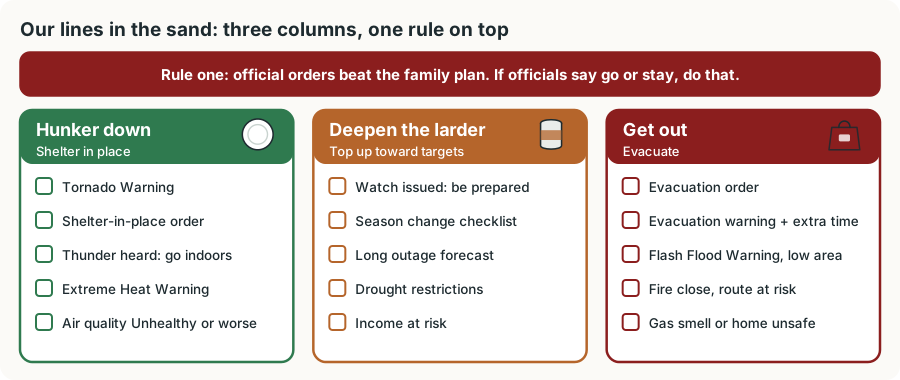
Decide ahead which official signals mean hunker down, deepen the larder, or get out. Fill it in once with the family trigger planner, read how it works, and review it each quarter. Rule one never changes: official orders beat the family plan.
All 52 meetings
January
- Week 1: Check every smoke alarm
- Week 2: Walk your fire escape plan
- Week 3: Space heater and fireplace check
- Week 4: Warm layers for every person
February
- Week 5: Count your water
- Week 6: Clean and fill one container
- Week 7: Find a good storage spot
- Week 8: Learn two ways to make water safe
March
- Week 9: Three days of food you already eat
- Week 10: Add a manual can opener
- Week 11: Fridge and freezer thermometers
- Week 12: Build up slowly, no debt
- Week 13: Rotate and check cans Trigger review
April
- Week 14: Check phone emergency alerts
- Week 15: Pick an out-of-area contact
- Week 16: Practise texting, not calling
- Week 17: Weather radio check
May
- Week 18: Check your first-aid supplies
- Week 19: Find a first-aid class
- Week 20: Write the medicine list
- Week 21: Medical alert and health info
June
- Week 22: Make your house number visible
- Week 23: Meet a neighbor
- Week 24: Test CO alarms
- Week 25: Set a family code word
- Week 26: Turn on multi-factor sign-in Trigger review
July
- Week 27: Plan a no-power meal
- Week 28: Check your outdoor cooking fuel
- Week 29: Fire extinguisher in the kitchen
- Week 30: Home canning: tested recipes only
August
- Week 31: Build the two-bucket toilet
- Week 32: Hand hygiene kit
- Week 33: Toilet paper and personal items
- Week 34: After an earthquake: don’t flush
September
- Week 35: Copy key documents
- Week 36: Small bills at home
- Week 37: Start a home inventory
- Week 38: Read your insurance
- Week 39: Back up your files Trigger review
October
- Week 40: A flashlight for every person
- Week 41: Know your utility shutoffs
- Week 42: Safe charging habits
- Week 43: Generator safety review
November
- Week 44: Kit check and rotate
- Week 45: Basic tools in one place
- Week 46: Spare glasses and personal items
- Week 47: Pet supplies
December
- Week 48: Car kit for winter
- Week 49: Keep the tank fuller
- Week 50: Plan two routes out
- Week 51: Paper map in the car
- Week 52: Year-end review Trigger review
Sources
- FEMA / Ready.gov: Make a Plan
- Utah DEM / Be Ready Utah: Make a Plan: Family
- American Red Cross: Make a Plan
- FEMA / Ready.gov: Helping Children Cope
Official pages checked 16 November 2026. Guidance changes; follow your local officials first. How we research.
Page checked on · Change log · Report an error · Calm by design