Plan
Family emergency plan
Your household may not be together when something happens. A plan settles ahead of time how you will get warnings, how you will reach each other, and where you will meet.[1]
Step 1: Talk it through
Ready.gov suggests starting with five questions:[1]
- How will we receive emergency alerts and warnings?
- What is our shelter plan?
- What is our evacuation route?
- What is our household communication plan?
- Do we need to update our emergency kit?
Step 2: Plan for everyone in the household
Ready.gov lists things to account for, including different ages, dietary and medical needs (prescriptions and equipment), disabilities or access and functional needs, languages spoken, pets or service animals, and school-aged children.[1]
If someone uses medical equipment that needs electricity, Ready.gov suggests talking with their doctor or health care provider about keeping it running in an outage, and asking your power provider about a priority restoration list.[2]
Step 3: Choose contacts and meeting places
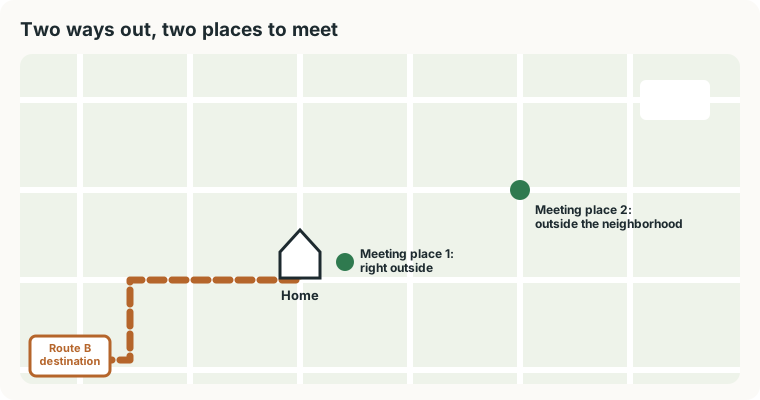
- Two meeting places. The Red Cross recommends one right outside your home for a sudden emergency such as a fire, and one outside your neighborhood in case you cannot return home.[3]
- An out-of-area contact. It may be easier to text or call long distance when local lines are overloaded.[3]
- Written contacts. Everyone should carry emergency contact information in writing and saved on their phones, and places like school or daycare should have the numbers too.[3]
Step 4: Decide where you would go
The Red Cross suggests deciding on a destination and route ahead of time, such as a hotel, the home of friends or relatives a safe distance away, or an evacuation shelter, and plotting alternate routes on a map.[3] Many public shelters and hotels do not allow pets inside, so plan pet-friendly options.[4]
Step 5: Write it down and practice
Use our worksheet or the official templates: Ready.gov Make a Plan (fillable form) and Red Cross family disaster plan template. Be Ready Utah recommends practicing your plans at least yearly and updating them as needed.[5]
Do this as a family. Each week has a ready-made 25-minute family meeting: this week’s task, one question to talk about, and a 5-minute practice. Every 13 weeks, review your family trigger planner: what signals mean hunker down, deepen the larder, or get out.
Sources
- FEMA / Ready.gov: Make a Plan
- FEMA / Ready.gov: People with Disabilities
- American Red Cross: Make a Plan
- FEMA / Ready.gov: Pets and Animals
- Utah DEM / Be Ready Utah: Make a Plan: Family
Official pages checked 14 November 2026. Guidance changes; follow your local officials first. How we research.
Page checked on · Change log · Report an error · Calm by design