Home / Topics / Food and nutrition
Food and nutrition · How-to
Food safety during a power outage
The rules that decide what stays and what goes.
Safety numbers are quoted, not invented. Every dose, time, temperature, and ratio on this page is copied from the agency named beside it. Where agencies differ, we show each one with its source instead of picking. If your local health department or officials give different instructions, follow them.
Before an outage
- Keep an appliance thermometer in both the refrigerator and freezer: the fridge at 40°F or below, the freezer at 0°F or below.[1]
- Keep the freezer full. Fill empty space with frozen jugs of water, bags of ice, or gel packs. Group foods together so they stay cold longer.[1]
- Have a large insulated cooler and frozen gel packs, and find out where to buy dry ice and block ice.[1]
During the outage
- Keep the doors closed.[1]
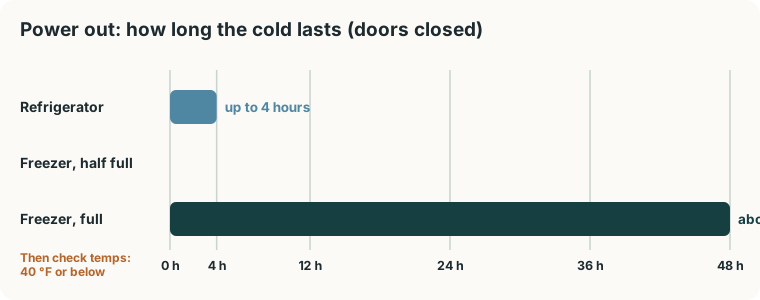
- Refrigerator: keeps food safe for up to 4 hours. After that, move food to a cooler with enough ice to hold it at 40°F or below.[1]
- Freezer: a full freezer holds its temperature about 48 hours, or 24 hours if it’s half full.[1]
- In snow, don’t put food outside. Make ice instead: fill buckets, milk jugs, or cans with water and leave them outside to freeze.[1]
Dry ice: two official figures
| Source | What it says |
|---|---|
| Ready.gov[2] | Twenty-five pounds of dry ice will keep a 10 cubic foot freezer below freezing for three to four days. |
| USDA FSIS[1] | Fifty pounds of dry ice should hold an 18-cubic-foot freezer for 2 days. |
Both agencies warn: don’t touch dry ice with bare hands (wear dry, heavy gloves), and don’t let it touch food.[2][1]
After the outage: keep or toss
Never taste food to decide if it’s safe. When in doubt, throw it out.[1] Ready.gov: throw away perishable food such as meat, poultry, fish, eggs, or leftovers that has been above 40°F for two hours or more.[2]
Discard if the fridge was off more than 4 hours
- Raw, cooked, or leftover meat, poultry, fish, eggs, and egg substitutes
- Luncheon meat and hot dogs
- Casseroles, soups, stews, and pizza
- Mixed salads (chicken, tuna, macaroni, potato)
- Gravy and stuffing
- Milk, cream, yogurt, sour cream, and soft cheeses
- Cut fresh fruits and vegetables; cooked vegetables
- Opened fruit and vegetable juices
- Creamy salad dressing
- Batters and doughs
- Custard, chiffon, or cheese pies; cream-filled pastries
- Garlic stored in oil
USDA FSIS list.[1] FSIS also says to discard opened mayonnaise, tartar sauce, and horseradish held above 50°F for over 8 hours.[1]
Generally safe (unless moldy or off)
- High-acid foods such as mustard, ketchup, relishes, pickles, non-creamy dressings, jams, and jellies (may spoil sooner)
- Whole fresh fruits and vegetables; unopened juices
- Dried fruits and coconut
- Baked goods such as fruit pies, bread, rolls, muffins, and cakes (not cream cheese frosting or cream fillings)
- Hard and processed cheeses; butter and margarine
- Fresh herbs and spices, flour, and nuts
USDA FSIS list.[1]
Frozen food
Food that has thawed but still has ice crystals, or that stayed at 40°F or below, can be safely refrozen, though the quality may suffer.[1][2]
Medicines
If the power is out for more than a day, Ready.gov says to discard any medication that should be refrigerated unless the label says otherwise, and to consult your doctor or pharmacist right away for a new supply.[3]
Cleaning a smelly fridge (USDA FSIS)
Throw away spoiled or questionable food. Wash the shelves and other parts with hot water and detergent, then rinse with a sanitizing solution of 1 tablespoon of unscented liquid chlorine bleach per gallon of drinking water. Leave the door open for about 15 minutes.[1]
USDA Meat and Poultry Hotline: 1-888-MPHotline (1-888-674-6854).[1]
Sources
- USDA Food Safety and Inspection Service: Keep Your Food Safe During Emergencies
- FEMA / Ready.gov: Food
- FEMA / Ready.gov: Power Outages
Official pages checked 14 November 2026. Guidance changes; follow your local officials first. How we research.
Page checked on · Change log · Report an error · Calm by design