Home / Topics / Hazard guides
Hazard guides · Guide
Tornadoes: before, during, and after
Utah has had tornadoes, including one in downtown Salt Lake City. A few minutes of planning tells everyone where to go.
On this page: What it is · Watch vs warning · Before · During · After
What it is
A tornado is a violently rotating column of air reaching from a thunderstorm to the ground. Tornadoes have been reported in all 50 states.[1] They can happen anytime and anywhere, with winds over 200 mph; the Midwest and Southeast have greater risk.[2] Utah has had them: on August 11, 1999, an F2 tornado with winds up to 157 mph tracked 4.3 miles across downtown Salt Lake City.[3]
Watch vs warning
Tornado Watch: be prepared. Tornadoes are possible; review your plan and be ready to act. Tornado Warning: take action. A tornado has been seen or indicated by radar; move to an interior room on the lowest floor of a sturdy building. Tornado Emergency: the NWS’s highest alert, for a violent tornado on the ground; seek shelter immediately.[4]
Before
- Know the signs: a rotating, funnel-shaped cloud, an approaching cloud of debris, or a loud roar like a freight train.[2]
- Sign up for alerts. If your community has sirens, learn the warning tone.[2]
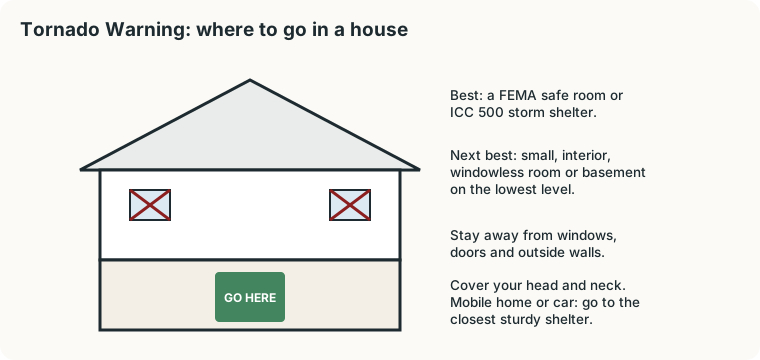
- Pick and practice your shelter: a FEMA-criteria safe room or ICC 500 storm shelter is best; next best is a small, interior, windowless room or basement on the lowest level of a sturdy building.[2]
- Include pets in the plan.[2]
During
- Go to your safe place immediately. Stay away from windows, doors, and outside walls, and protect your head and neck with your arms and with furniture or blankets.[2]
- In a mobile home, a vehicle, or outdoors, move to the closest substantial shelter and protect yourself from flying debris.[4]
- In a car there is no safe option, only less dangerous ones. Ready.gov says if the tornado is visible, far away, and traffic is light, you may be able to drive at right angles out of its path; if you are caught by extreme winds, park out of traffic, stay buckled, and get your head below the windows.[2] The NWS adds: don’t try to outrun an approaching tornado in a vehicle.[4]
- Don’t shelter under bridges.[2]
After
- Keep listening to alerts and officials. Text or use social media instead of calling, to keep lines open.[2]
- Stay clear of fallen power lines and broken utility lines.[2]
- Wear thick-soled shoes, long pants, and work gloves for cleanup.[2]
Official orders come first. If officials tell you to evacuate or shelter, do that. Not sure? Try the stay or go tool.
Related
Thunderstorms and lightning · Shelter in place · Alerts and weather radio
Sources
- NOAA National Weather Service: Tornado Safety
- FEMA / Ready.gov: Tornadoes
- Utah Division of Emergency Management: Severe Weather
- NOAA National Weather Service: Understand Tornado Alerts
Official pages checked 14 November 2026. Guidance changes; follow your local officials first. How we research.
Page checked on · Change log · Report an error · Calm by design