Kit guide · Security
Home fire safety kit: alarms, extinguisher, and escape plan
The most likely emergency in most homes is a fire. This is the gear and the plan.
How to use this guide: follow the steps, tick off the checklist, then print it . The printout has no shopping links.
Stay-Go Guide · Home fire safety kit: alarms, extinguisher, and escape plan · Checked: ____________
What to do
- Put smoke alarms in every bedroom, outside each sleeping area, and on every level, including the basement.[1] USFA recommends dual-sensor alarms, or both ionization and photoelectric types, and interconnected alarms so one sounds them all.[1]
- Test alarms. USFA says monthly.[1] Ready.gov’s escape-plan page says twice a year.[2] Monthly meets both. Replace the whole alarm every 10 years.[1]
- Add CO alarms with battery backup on every level.[3]
- Choose an extinguisher. USFA says multipurpose “A-B-C” extinguishers cover most home fires; look for the UL label and choose the largest one you can comfortably operate.[4] Young children and older adults should not use extinguishers.[4]
- Make and practice an escape plan. Two ways out of every room, a meeting place outside, and a drill at least twice a year. Practice getting out in under 2 minutes.[2] An upper-floor room may need an escape ladder.[2]
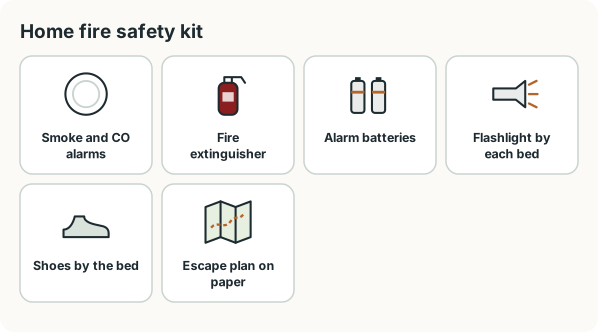
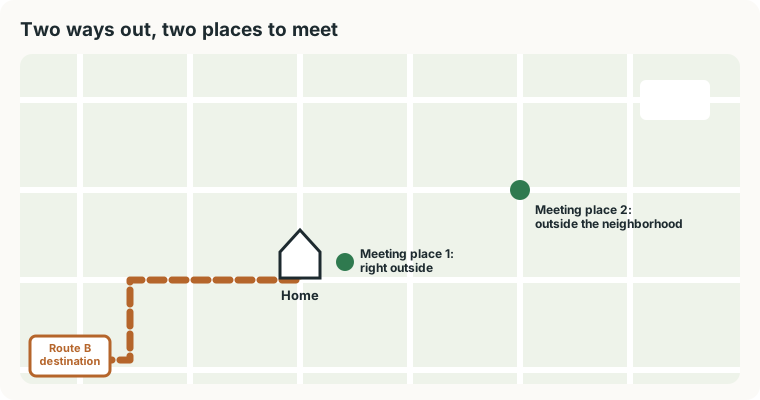
The checklist
Quantities come from the source cited beside them. † marks our packing suggestion where the official list gives no number.
| Item | How many | Why | |
|---|---|---|---|
| Smoke alarms (dual-sensor, interconnected) | Every bedroom, outside each sleeping area, every level | USFA.[1] | |
| CO alarms with battery backup | 1 per level | Ready.gov.[3] | |
| Multipurpose A-B-C fire extinguisher, UL listed | 1 or more† | USFA.[4] | |
| Escape ladder for second-floor bedrooms | 1 per bedroom above the ground floor† | Ready.gov escape plan.[2] | |
| Flashlight by each bed | 1 per person | Be Ready Utah: flashlights near beds.[5] | |
| Spare alarm batteries (if not sealed 10-year) | 1 set per alarm† | Keep alarms working. |
Nice to have (not on the official lists)
Optional extras we think are useful. They are our suggestions, not agency recommendations.
| Item | How many | Why | |
|---|---|---|---|
| Fire blanket for the kitchen | 1 | An extra tool for small pan fires. Learn how before you need it. | |
| Strobe or vibrating alarm for anyone with hearing loss | As needed | USFA notes alarms with strobes or vibration exist for people with hearing loss.[1] |
Some fire departments offer free or reduced-price smoke alarms. Call your local fire department’s non-emergency number.[1]
Build it on a budget
Ready.gov suggests building a kit over time, starting with what you already have, and checking garage sales and thrift stores.[6] Tiers add up: each one builds on the one before. Dollar amounts are rough planning targets, not price quotes; prices vary.
$0 (Free: gather from home)
- Test existing smoke alarms
- Plan two ways out of every room
- Ask the fire department about free alarms
$50
- Replacement smoke alarm
- Batteries
$150
- A-B-C extinguisher
- CO alarm
- Escape ladder for an upstairs room
$500
- Interconnected alarms throughout the home
Shop this list
Affiliate disclosure: the shopping links below are Amazon affiliate links. As an Amazon Associate we earn from qualifying purchases, at no extra cost to you. They are generic search links, not endorsements of a brand. Full disclosure.
These are generic Amazon searches, not picks of a specific brand. Compare ratings, check what fits your household, and buy only what you don’t already own. Most of this list can come from around your home.
- Smoke alarms (dual-sensor, interconnected) (Amazon)
- CO alarms with battery backup (Amazon)
- Multipurpose A-B-C fire extinguisher, UL listed (Amazon)
- Escape ladder for second-floor bedrooms (Amazon)
- Flashlight by each bed (Amazon)
- Spare alarm batteries (if not sealed 10-year) (Amazon)
- Fire blanket for the kitchen (Amazon)
- Strobe or vibrating alarm for anyone with hearing loss (Amazon)
Sources
- U.S. Fire Administration: Smoke Alarms
- FEMA / Ready.gov: Home Fire Escape Plan
- FEMA / Ready.gov: Power Outages
- U.S. Fire Administration: Fire Extinguishers
- Utah DEM / Be Ready Utah: Light & Power (12 Areas)
- FEMA / Ready.gov: Low and No Cost Preparedness
Official pages checked 14 November 2026. Guidance changes; follow your local officials first. How we research.
Page checked on · Change log · Report an error · Calm by design