Water · How-to
How to disinfect water with bleach
Bleach amounts by bottle strength, from CDC, EPA, and Ready.gov, quoted exactly.
Safety numbers are quoted, not invented. Every dose, time, temperature, and ratio on this page is copied from the agency named beside it. Where agencies differ, we show each one with its source instead of picking. If your local health department or officials give different instructions, follow them.
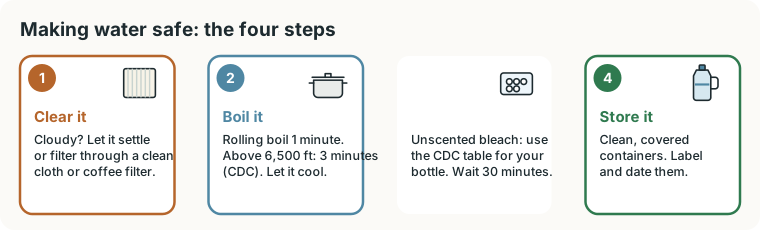
If you can’t boil water, regular unscented household bleach kills most germs. The amount depends on the strength printed on your bottle, so read the label first. Three federal sources publish slightly different instructions. All three are below, exactly as published, so you can match your bottle to a table.
Before you start
- Use the right bleach. Regular, unscented chlorine bleach only. Do not use scented, color-safe, or bleaches with added cleaners.[2][3]
- Check the strength. CDC says to follow the label’s instructions for disinfecting drinking water if it has them. If not, find the sodium hypochlorite percentage under “active ingredient.” In the United States it is typically between 5% and 9%.[1]
- Use fresh bleach. EPA says to use fresh liquid chlorine bleach, or bleach stored at room temperature for less than one year.[2]
- Clear cloudy water first. Filter it through a clean cloth, paper towel, or coffee filter, or let it settle.[1]
- Know the limits. Disinfectants don’t work as well as boiling against some germs, including the parasites Cryptosporidium and Giardia.[1] Bleach also cannot fix water contaminated with fuel or toxic chemicals.[1]
CDC instructions
- Find your bleach strength (label or active ingredient).
- Add the amount from the table that matches your strength. If the water is cloudy, murky, colored, or very cold, add double the amount.
- Stir well.
- Let the water stand for at least 30 minutes before you drink it.[1]
- Store it in clean, sanitized containers with tight covers.
| Amount of water | With a dropper | With a mL measure | With a measuring spoon |
|---|---|---|---|
| 1 quart or liter | 2 drops | 0.1 mL | a tiny amount (too small to measure) |
| 1 gallon | 8 drops | ½ mL | a little less than ⅛ teaspoon |
| 5 gallons | 40 drops | 2½ mL | ½ teaspoon |
| Amount of water | With a dropper | With a mL measure | With a measuring spoon |
|---|---|---|---|
| 1 quart or liter | 10 drops | ½ mL | ⅛ teaspoon |
| 1 gallon | 40 drops | 2½ mL | ½ teaspoon |
| 5 gallons | 200 drops | 12½ mL | 2½ teaspoons |
EPA instructions
- Use a clean dropper from your medicine cabinet or emergency kit.
- Add the amount from the table for your bleach strength. Double it if the water is cloudy, colored, or very cold.
- Stir and let stand for 30 minutes.
- Smell it. The water should have a slight chlorine odor. If it doesn’t, repeat the dosage and let it stand another 15 minutes before use.[2]
- If the chlorine taste is too strong, pour the water between clean containers and let it stand for a few hours.[2]
| Volume of water | 6% bleach | 8.25% bleach |
|---|---|---|
| 1 quart/liter | 2 drops | 2 drops |
| 1 gallon | 8 drops | 6 drops |
| 2 gallons | 16 drops (1/4 tsp) | 12 drops (1/8 teaspoon) |
| 4 gallons | 1/3 teaspoon | 1/4 teaspoon |
| 8 gallons | 2/3 teaspoon | 1/2 teaspoon |
Ready.gov instructions (page last updated 2021)
Ready.gov says to use only regular household liquid bleach that contains 5.25 to 6.0 percent sodium hypochlorite. Add 1/8 teaspoon of bleach per gallon of water, stir, and let it stand for 30 minutes. The water should have a slight bleach odor. If it doesn’t, repeat the dose and let it stand another 15 minutes. If it still does not smell of chlorine, discard it and find another source of water.[3]
Where the sources differ
- Strength range. Ready.gov’s instructions cover 5.25–6% bleach. CDC’s cover 5–9% and 1%. EPA’s cover 6% and 8.25%. Many bottles sold now are stronger than 6%, so use the CDC or EPA table that matches your label.
- Per-gallon amount. CDC gives 8 drops (a little less than ⅛ teaspoon) per gallon for 5–9% bleach. EPA gives 8 drops for 6% and 6 drops for 8.25%. Ready.gov gives 1/8 teaspoon for 5.25–6%.
- Smell test. EPA and Ready.gov tell you to check for a slight chlorine smell and re-dose if it’s missing. CDC’s page does not include this step.
Keep a card with your kit. Write your bleach brand, its percentage, and the matching line from one table on an index card. Tape it to your water containers. A bottle opened years ago may no longer match.
Sources
- CDC: How to Make Water Safe in an Emergency
- U.S. EPA: Emergency Disinfection of Drinking Water
- FEMA / Ready.gov: Water
Official pages checked 14 November 2026. Guidance changes; follow your local officials first. How we research.
Page checked on · Change log · Report an error · Calm by design