Kit guide · Food and nutrition
Two-week food supply kit
Foods you already eat, enough for two weeks, stored so they last.
How to use this guide: follow the steps, tick off the checklist, then print it . The printout has no shopping links.
Stay-Go Guide · Two-week food supply kit · Checked: ____________
What to do
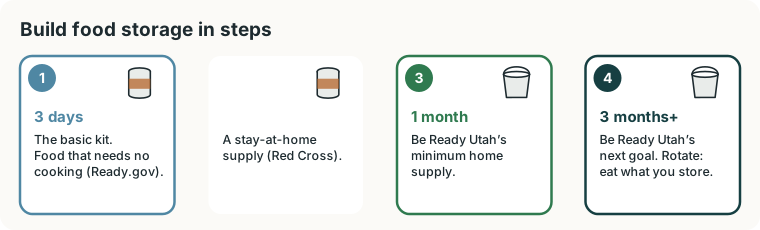
- Start with three days, then build. Be Ready Utah: start with a three-day supply, work toward a minimum one-month supply each, then three months or more.[1]
- Buy what you already eat. Be Ready Utah: “eat what you store and store what you eat,” and rotate.[1] Don’t store foods anyone is allergic to.[1]
- Build gradually. Cover all areas of nutrition and don’t go into debt.[1]
- Store it right: cool, dark, and dry, off floors and walls. Be Ready Utah says every 18°F above the ideal 40–70°F halves shelf life.[1]
- Rotate. Most off-the-shelf foods have a shelf life of less than a year.[1] See building an emergency food supply.
The checklist
Quantities come from the source cited beside them. † marks our packing suggestion where the official list gives no number.
| Item | How many | Why | |
|---|---|---|---|
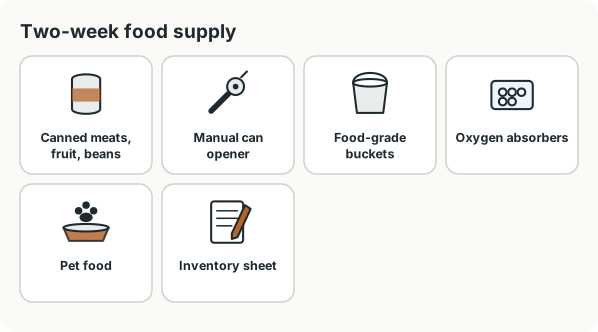
| Ready-to-eat canned meats, fruits, vegetables, beans | Enough for 2 weeks for your household† | Ready.gov suggests foods that need no refrigeration, preparation, or cooking.[2] | |
| Protein or fruit bars, dry cereal, peanut butter, dried fruit, nuts, crackers | As above† | From Ready.gov’s food list.[2] | |
| Manual can opener | 1 | Ready.gov basic list.[3] | |
| Food-grade buckets or #10 cans (for longer storage) | As needed | Be Ready Utah names food-grade buckets and #10 cans.[1] | |
| Oxygen absorbers | Be Ready Utah: one 300cc packet per gallon container | For dry foods in sealed containers.[1] Only for dry foods with 10% moisture or less.[1] | |
| Pet food | Several days or more | Be Ready Utah: plenty of pet food.[1] | |
| Inventory sheet and marker | 1 | Date everything and use oldest first. |
Nice to have (not on the official lists)
Optional extras we think are useful. They are our suggestions, not agency recommendations.
| Item | How many | Why | |
|---|---|---|---|
| Can rotation rack | 1 | Makes first-in, first-out automatic. | |
| Camp stove (outdoor use only) | 1 | For cooking outside during an outage. Keep it at least 20 feet from windows.[4] |
Build it on a budget
Ready.gov suggests building a kit over time, starting with what you already have, and checking garage sales and thrift stores.[5] Tiers add up: each one builds on the one before. Dollar amounts are rough planning targets, not price quotes; prices vary.
$0 (Free: gather from home)
- An inventory of what is already in the pantry
- Manual can opener if you have one
$50
- A few extra cans and dry goods each shop
- Manual can opener
$150
- A full week of shelf-stable food you eat
- Storage bins with lids
$500
- Two weeks of food for everyone, rotated
- Outdoor camp stove and fuel
Shop this list
Affiliate disclosure: the shopping links below are Amazon affiliate links. As an Amazon Associate we earn from qualifying purchases, at no extra cost to you. They are generic search links, not endorsements of a brand. Full disclosure.
These are generic Amazon searches, not picks of a specific brand. Compare ratings, check what fits your household, and buy only what you don’t already own. Most of this list can come from around your home.
Sources
- Utah DEM / Be Ready Utah: Food (12 Areas)
- FEMA / Ready.gov: Food
- FEMA / Ready.gov: Build A Kit
- FEMA / Ready.gov: Power Outages
- FEMA / Ready.gov: Low and No Cost Preparedness
Official pages checked 14 November 2026. Guidance changes; follow your local officials first. How we research.
Page checked on · Change log · Report an error · Calm by design