Home / Topics / Light and power
Light and power · How-to
Portable generator safety
Generators help in outages, and they can kill if used wrong.
Safety numbers are quoted, not invented. Every dose, time, temperature, and ratio on this page is copied from the agency named beside it. Where agencies differ, we show each one with its source instead of picking. If your local health department or officials give different instructions, follow them.
Generators kill people every year. CPSC says more than 100 of the over 200 yearly U.S. deaths from accidental non-fire carbon monoxide poisoning linked to consumer products are tied to portable generators. One portable generator can make as much CO as hundreds of cars.[1]
The placement rule
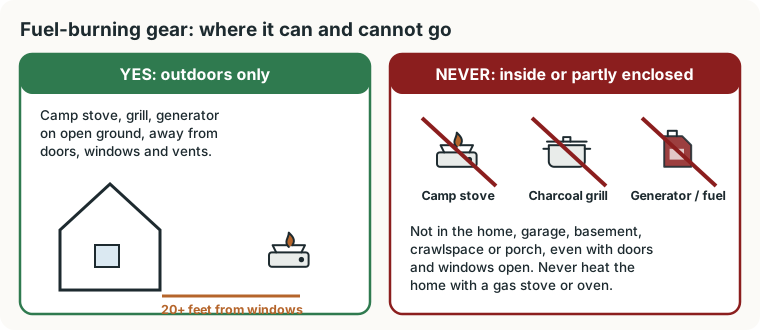
- Outdoors only, at least 20 feet from windows, doors, and attached garages (Ready.gov)[2], with the exhaust pointed away from the home (CPSC).[1]
- Never inside a home, garage, basement, crawlspace, or any partially enclosed area, even with the doors and windows open.[3][1] Red Cross: opening doors and windows or using fans will not prevent CO buildup.[3]
Shock and fire
- Keep the generator dry. Don’t use it in rain or wet conditions. Run it on a dry surface under an open, canopy-like structure, and don’t touch it with wet hands.[3]
- Turn it off and let it cool before refueling. Fuel spilled on hot engine parts can ignite.[3][2]
- Plug appliances directly into the generator, or use a heavy-duty, outdoor-rated extension cord rated at least equal to the total connected load. Check that the cord has no cuts and the plug has all three prongs.[3]
- Never plug a generator into a wall outlet. This “backfeeding” puts utility workers, your neighbors, and your household at risk of electrocution. To connect a generator to house wiring, have an electrician install a transfer switch to code.[3]
- Stagger equipment run times to avoid overloads.[3]
Fuel storage
- Use an approved safety can and the fuel type the generator calls for.[3]
- Local laws may limit how much fuel you can store and where. Ask your local fire department.[3]
- Store fuel outside living areas, in a locked shed or other protected area, and away from fuel-burning appliances such as a gas water heater in a garage.[3]
What size generator? (Red Cross method)
- Add up the wattage of the appliances and devices you want to run. Check the label on the back or side.
- Add the wattage of the light bulbs you want to use.
- Find total amps: divide watts by volts. Most household devices run on 120 volts, and most major appliances with the large plug need 240.
- Choose a generator that produces more amps than you need. Some machines draw up to 3 times as much power when starting up, and others lose efficiency over time.[3]
Red Cross says the best option is a permanently installed stationary generator, and suggests asking an electrician if your needs are complicated.[3]
See also: carbon monoxide safety.
Sources
- U.S. Consumer Product Safety Commission: Carbon Monoxide Information Center
- FEMA / Ready.gov: Power Outages
- American Red Cross: Safe Generator Use
Official pages checked 14 November 2026. Guidance changes; follow your local officials first. How we research.
Page checked on · Change log · Report an error · Calm by design