Home / Topics / Hazard guides
Hazard guides · Guide
Landslides and post-fire debris flows: before, during, and after
After a wildfire, even a modest rainstorm can send mud and rock racing down burned slopes. Knowing the signs, and leaving early, is what protects lives.
On this page: What it is · Before · Warning signs · During · After
What it is
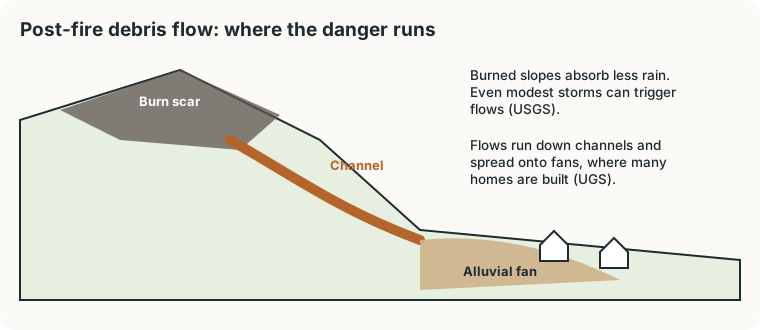
A landslide is rock, mud, or debris moving down a slope. When a wildfire burns a slope, it raises the chance of landslides for several years.[1] Debris flows are fast-moving slurries of rock, mud, plants, and water that run down channels onto alluvial fans, and they often happen after wildfires.[2] Alluvial fans are also popular places to build homes.[2] After a fire the ground absorbs less rain, so even modest storms can trigger flash floods and debris flows. These flows often move faster than a person can run and can travel far beyond the burned area.[3]
Before
- If you live near a wildfire burn area, sign up for emergency alerts and watch the weather forecast for the burn area.[1]
- Plan to leave: evacuation is often the only way to protect lives from a debris flow.[1]
- Look for landslide and geologic maps from your state geological survey or county. A missing landslide on a map does not mean there is no hazard.[4]
- Check where gutters and driveways send stormwater. Don’t dump yard waste or debris on a slope.[4]
- Talk to your insurance agent. Debris flow may be covered by National Flood Insurance Program policies.[1] For property protection, get advice from a qualified geotechnical professional.[1]
Warning signs
- Rushing water, mud, or unusual sounds such as trees cracking or boulders knocking together; a faint rumble that grows louder.[1]
- A stream that suddenly rises or drops, or changes from clear to muddy.[1]
- Slow slides: doors or windows sticking for the first time, new cracks in plaster or foundations, tilting fences or poles, bulging ground at the base of a slope.[1]
During
- Leave if you are told to evacuate or feel it is unsafe to stay.[1] Follow your local emergency managers.[1]
- Stay awake and alert during storms that could cause a slide. Many landslide deaths happen while people are asleep.[1]
- By the time you are sure a debris flow is coming, it is too late to get away safely. Never cross a road with water or mud flowing, or a bridge if a flow is coming.[1]
- If you are caught in the path of a slide, move uphill as fast as you can. Avoid river valleys and low areas.[1]
After
- Stay away from the slide area; more slides can follow, and so can flooding.[1]
- Check for injured or trapped people near the slide without entering it, and direct rescuers to them. Report broken utility lines and damaged roads.[1]
- Have trained professionals check the foundation, chimney, and surrounding land. Replant damaged ground soon to limit erosion.[1]
Official orders come first. If officials tell you to evacuate or shelter, do that. Not sure? Try the stay or go tool.
Related
Wildfire · Floods and flash floods · Insurance and documents · Family trigger planner
Sources
- FEMA / Ready.gov: Landslides & Debris Flow
- Utah Geological Survey: Debris Flows
- U.S. Geological Survey: Postfire Debris-Flow Hazards
- U.S. Geological Survey: Landslide Preparedness
Official pages checked 14 November 2026. Guidance changes; follow your local officials first. How we research.
Page checked on · Change log · Report an error · Calm by design