Kit guide · Shelter in place
Home 72-hour bin: the Ready.gov basic kit, packed
The Ready.gov basic kit, packed into one bin at home, plus how to grow it past three days.
How to use this guide: follow the steps, tick off the checklist, then print it . The printout has no shopping links.
Stay-Go Guide · Home 72-hour bin: the Ready.gov basic kit, packed · Checked: ____________
What to do
- Pick one or two easy-to-carry containers. Ready.gov suggests plastic bins or a duffel bag.[1]
- Fill it from the checklist. Store items in airtight plastic bags.[1]
- Keep it in one designated place and make sure everyone knows where it is.[1]
- Grow it past 72 hours. The Red Cross says a 2-week supply of food and water for home,[2] and Be Ready Utah works from three days toward a minimum one-month food supply.[3]
- Maintain it. Keep canned food cool and dry, keep boxed food in tightly closed plastic or metal containers, and replace expired items.[1]
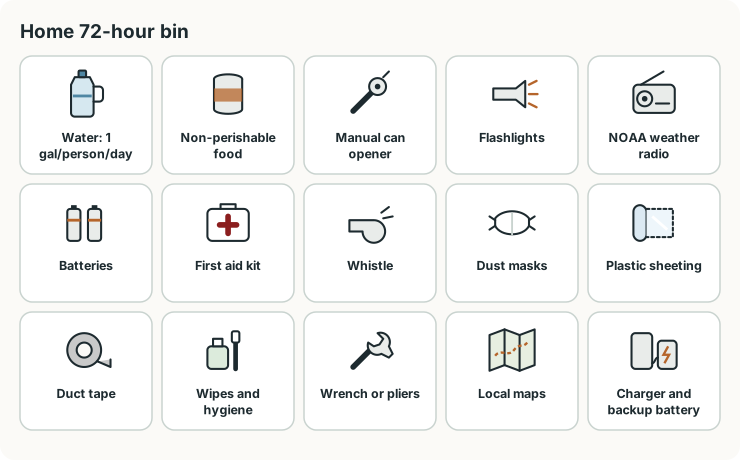
The checklist
Quantities come from the source cited beside them. † marks our packing suggestion where the official list gives no number.
| Item | How many | Why | |
|---|---|---|---|
| Water | 1 gallon per person per day, several days[1] | Drinking and sanitation. See the water kit. | |
| Non-perishable food | At least a several-day supply[1] | Foods your family already eats. | |
| Manual can opener | 1 | Ready.gov basic list.[1] | |
| Battery or hand-crank radio + NOAA Weather Radio with tone alert | 1 | Ready.gov basic list.[1] | |
| Flashlights and extra batteries | 1 per person[4] | Ready.gov basic list.[1] | |
| First aid kit | 1 | Ready.gov basic list.[1] See first aid kits. | |
| Whistle | 1 per person† | To signal for help.[1] | |
| Dust masks | 1 or more per person† | To help filter contaminated air.[1] | |
| Plastic sheeting, scissors, duct tape | 1 roll each† | To shelter in place.[1] | |
| Moist towelettes, garbage bags, plastic ties | 1 pack each† | For personal sanitation.[1] | |
| Wrench or pliers | 1 | To turn off utilities.[1] | |
| Local maps | 1 | Ready.gov basic list.[1] | |
| Phone chargers and backup battery | 1 per phone† | Ready.gov basic list.[1] | |
| Soap, hand sanitizer, disinfecting wipes | 1 each† | Ready.gov additional supplies.[1] | |
| Sleeping bag or warm blanket | 1 per person[1] | For cold nights without heat. | |
| Fire extinguisher | 1† | Ready.gov additional supplies.[1] See the fire safety kit. | |
| Matches in a waterproof container | 1† | Ready.gov additional supplies.[1] | |
| Mess kits, cups, plates, paper towels, utensils | 1 set per person† | Ready.gov additional supplies.[1] | |
| Paper and pencil; books and games for kids | 1 set† | Ready.gov additional supplies.[1] |
Build it on a budget
Ready.gov suggests building a kit over time, starting with what you already have, and checking garage sales and thrift stores.[5] Tiers add up: each one builds on the one before. Dollar amounts are rough planning targets, not price quotes; prices vary.
$0 (Free: gather from home)
- A bin or box you own
- Three days of water filled from the tap
- Three days of pantry food
- Flashlight, can opener, blankets from home
$50
- Batteries
- Basic first-aid supplies
- Plastic sheeting and duct tape
- Wrench or pliers for utilities
$150
- NOAA weather radio
- Lanterns
- Dedicated water containers
$500
- Two weeks of water and food
- Power station or solar charger
Shop this list
Affiliate disclosure: the shopping links below are Amazon affiliate links. As an Amazon Associate we earn from qualifying purchases, at no extra cost to you. They are generic search links, not endorsements of a brand. Full disclosure.
These are generic Amazon searches, not picks of a specific brand. Compare ratings, check what fits your household, and buy only what you don’t already own. Most of this list can come from around your home.
- Water (Amazon)
- Manual can opener (Amazon)
- NOAA weather radio hand crank battery (Amazon)
- Flashlights and extra batteries (Amazon)
- First aid kit (Amazon)
- Whistle (Amazon)
- Dust masks (Amazon)
- Plastic sheeting, scissors, duct tape (Amazon)
- Moist towelettes, garbage bags, plastic ties (Amazon)
- Wrench or pliers (Amazon)
- Local maps (Amazon)
- Phone chargers and backup battery (Amazon)
- Sleeping bag or warm blanket (Amazon)
- Fire extinguisher (Amazon)
- Matches in a waterproof container (Amazon)
Sources
- FEMA / Ready.gov: Build A Kit
- American Red Cross: Survival Kit Supplies
- Utah DEM / Be Ready Utah: Food (12 Areas)
- FEMA / Ready.gov: Power Outages
- FEMA / Ready.gov: Low and No Cost Preparedness
Official pages checked 14 November 2026. Guidance changes; follow your local officials first. How we research.
Page checked on · Change log · Report an error · Calm by design