Kit guide · Water
Water storage and purification kit
Stored water first, then the gear to make more water safe.
How to use this guide: follow the steps, tick off the checklist, then print it . The printout has no shopping links.
Stay-Go Guide · Water storage and purification kit · Checked: ____________
What to do
- Work out how much. At least 1 gallon per person per day.[1] CDC says at least 3 days and 2 weeks if possible.[1] Be Ready Utah sets a minimum 2-week supply, 14 gallons each.[2] Use the water calculator.
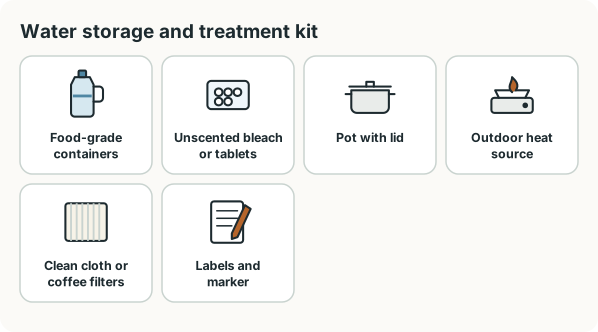
- Buy or clean containers. Unopened commercial bottled water is the safest choice.[1] If you fill your own, CDC recommends FDA-approved food-grade containers, never ones that held toxic chemicals.[1] Clean them first: how to clean and fill containers.
- Label and store. Label each container “drinking water” with the date and keep it at 50–70°F, out of sunlight, away from gasoline and pesticides.[1]
- Rotate. Replace water you bottled yourself every six months.[1]
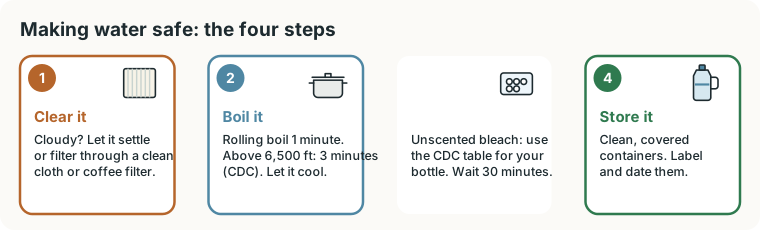
- Keep a way to treat more. Learn boiling and bleach disinfection before you need them. Portable filters don’t remove viruses, so CDC says to add a chemical disinfectant after filtering.[3]
The checklist
Quantities come from the source cited beside them. † marks our packing suggestion where the official list gives no number.
| Item | How many | Why | |
|---|---|---|---|
| Stored drinking water | 1 gallon per person per day × days you plan for[1] | Drinking and sanitation. More for hot weather, children, nursing mothers, and sick people. | |
| Food-grade water containers | Enough for your total† | CDC: FDA-approved food-grade storage containers.[1] | |
| Regular unscented chlorine bleach | 1 bottle, replaced as it ages† | EPA: only regular, unscented chlorine bleach suitable for disinfection, not scented, color-safe, or with added cleaners.[4] Doses by source are in our bleach guide. | |
| Medicine dropper | 1† | For measuring bleach drops. Keep it only for water treatment. | |
| Clean cloth or coffee filters | 1 pack | CDC: filter cloudy water through a clean cloth, paper towel, or coffee filter, or let it settle first.[3] | |
| Pot with lid and a heat source you can use outdoors | 1 | For boiling. Never run camp stoves indoors.[5] | |
| Labels and a marker | 1 set | For the “drinking water” label and date.[1] |
Nice to have (not on the official lists)
Optional extras we think are useful. They are our suggestions, not agency recommendations.
| Item | How many | Why | |
|---|---|---|---|
| Water container spigot or pump | 1 | Makes heavy containers easier to pour. | |
| Portable water filter | 1 | Useful with a disinfectant afterward. See filters and tablets. | |
| Collapsible water jugs | 2 | For carrying water from a distribution point. |
Build it on a budget
Ready.gov suggests building a kit over time, starting with what you already have, and checking garage sales and thrift stores.[6] Tiers add up: each one builds on the one before. Dollar amounts are rough planning targets, not price quotes; prices vary.
$0 (Free: gather from home)
- Clean food-grade bottles you already have
- Tap water
- Plain unscented bleach if you have it
- A pot to boil water
$50
- Food-grade water containers
- Fresh plain bleach and a dropper
$150
- Several large containers toward two weeks
- Portable water filter
$500
- Two weeks or more of stored water for everyone
- Water storage barrel with pump
Shop this list
Affiliate disclosure: the shopping links below are Amazon affiliate links. As an Amazon Associate we earn from qualifying purchases, at no extra cost to you. They are generic search links, not endorsements of a brand. Full disclosure.
These are generic Amazon searches, not picks of a specific brand. Compare ratings, check what fits your household, and buy only what you don’t already own. Most of this list can come from around your home.
Sources
- CDC: How to Create an Emergency Water Supply
- Utah DEM / Be Ready Utah: Water (12 Areas)
- CDC: How to Make Water Safe in an Emergency
- U.S. EPA: Emergency Disinfection of Drinking Water
- FEMA / Ready.gov: Power Outages
- FEMA / Ready.gov: Low and No Cost Preparedness
Official pages checked 14 November 2026. Guidance changes; follow your local officials first. How we research.
Page checked on · Change log · Report an error · Calm by design